

Register now for the new AHDB EUDR geolocation portal. Register

BMPA Chief Executive John Powell appeared before the Senedd’s Climate Change, Environment, Sustainability and Rural Affairs Committee on Wednesday 18 November as part of its inquiry into the future of Welsh abattoirs.
The evidence session examined the mounting pressures facing both large and small abattoirs, including declining livestock numbers, rising operating costs, workforce shortages and the implications for Wales’s food supply chain.
Central to BMPA’s evidence was the warning that falling livestock numbers pose a serious threat to the viability of larger processing plants, which handle more than 90% of meat production. With abattoirs operating on tight margins, reduced throughput can quickly make operations uneconomic. The loss of a major processing facility would have severe consequences for farmers, employment and domestic food security, particularly as capacity lost through closure is rarely replaced.
To address this, BMPA is proposing a time-limited Welsh Government and industry task and finish group to examine practical ways of stabilising and rebuilding livestock numbers. This would bring together farming, processing and livestock marketing organisations to consider measures ranging from productivity and breeding improvements to financial incentives for farmers and support for new entrants.
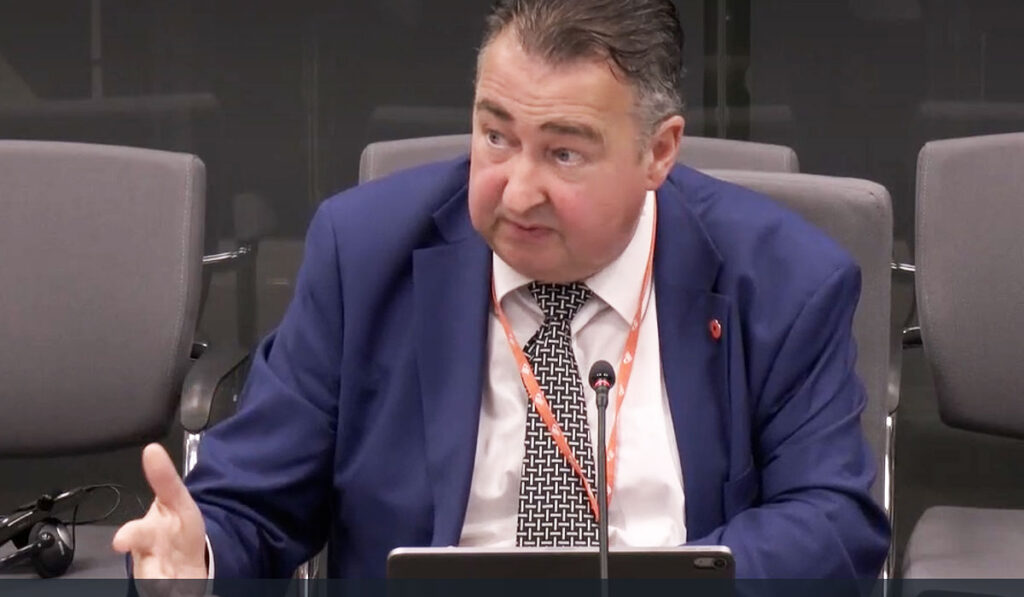
John Powell giving evidence before the Senedd’s Climate Change, Environment, Sustainability and Rural Affairs Committee
At the hearing, John also highlighted the important role of smaller abattoirs in supporting local food supply chains, native and rare breeds, and animal welfare by reducing the distances livestock must travel to slaughter. However, stressed that these businesses face specific challenges around succession, skilled labour, operating costs and declining throughput.
Linking this discussion to the Brexit re-set discussions happening right now, and from a wider trade perspective, another opportunity lies in a future UK-EU Sanitary and Phytosanitary (SPS) agreement. By reducing export certification costs and barriers to trade, closer alignment could benefit smaller abattoirs that have struggled to access EU markets since Brexit, as well as the larger export-focused processors. John elaborated on how this could be leveraged during the session.
BMPA’s wider evidence also addressed the need for fairer Food Standards Agency charges, greater investment in workforce skills and a more joined-up approach to securing the long-term resilience of the Welsh meat supply chain.
John went to the hearing armed with a persuasive array of insights and on-the-ground examples of the challenges the British meat and livestock industry is facing as well as some clear suggestions for how to tackle them. We’d encourage all our members and subscribers to give it a listen.
Watch the recording of John Powell’s evidence to the Senedd Committee: Senedd committee meeting – 18 November 2026
We are the UKs largest trade body for the meat industry and provide expert advice on trade issues, bespoke technical advice and access to government policy makers
We are proud to count businesses of all sizes and specialties as members. They range from small, family run abattoirs serving local customers to the largest meat processing companies responsible for supplying some of our best-loved brands to shops and supermarkets.
We are further strengthened by our associate Members who work in industries that support and supply our meat processing companies.
We are the voice of the British meat industry.

17 Clerkenwell Green
Clerkenwell, EC1 0DP
Tel: 020 7329 0776
Get industry updates direct to your inbox